Last updated: 11 April 2026 · Report an issue
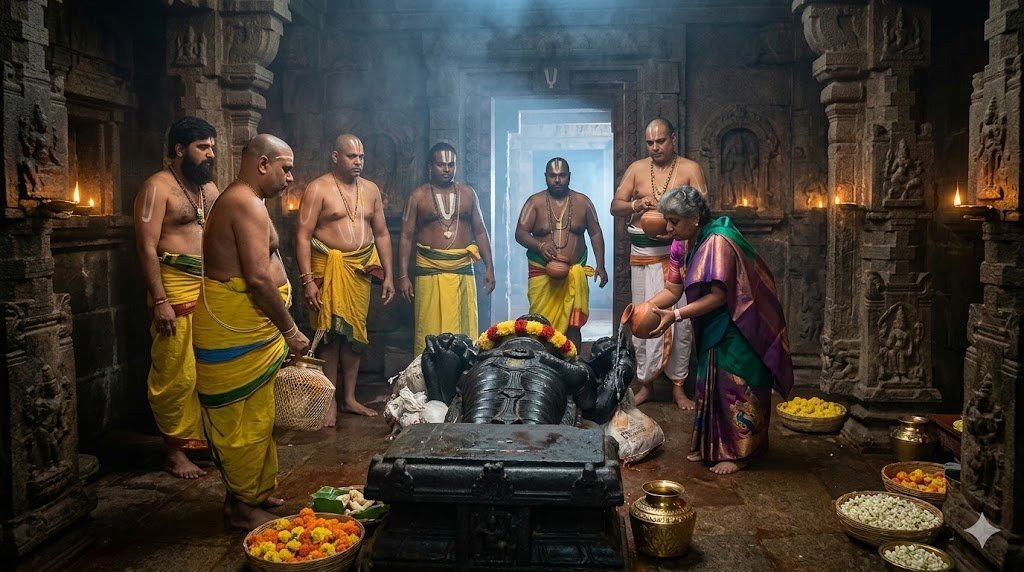
Sarpa Dosha Nivarana at Kukke Subramanya Temple
Kukke Shri Subrahmanya Temple is universally recognized as the most powerful
and effective centre in India for Sarpa Dosha Nivarana — the
neutralization and removal of serpent-related astrological afflictions. For
thousands of years, devotees have journeyed to this sacred site to seek relief
from the debilitating effects of Sarpa Dosha, Kala Sarpa Dosha, and Naga Dosha
through specially designed Vedic rituals performed under the eternal
protection of Lord Subrahmanya.
This page provides an authoritative and comprehensive guide to understanding
serpent doshas, their astrological indicators, symptoms, and the specific
remedial rituals available at Kukke Subramanya Temple.
What is Sarpa Dosha?
Sarpa Dosha (also written as Sarpa Dosh) is an astrological
affliction found in a person’s birth chart (Kundali/Jataka) caused by the
malefic positioning of the shadow planets Rahu and
Ketu — the north and south lunar nodes. In Vedic astrology,
Rahu and Ketu are considered the head and tail of the cosmic serpent
respectively. When these planets occupy certain positions in the horoscope,
they create doshas (flaws) that are believed to bring various difficulties and
obstacles in a person’s life.
The concept of Sarpa Dosha is deeply rooted in Hindu mythology. According to
the Puranas, Rahu and Ketu were originally parts of the demon Swarbhanu, who
was beheaded by Lord Vishnu’s Sudarshana Chakra during the churning of the
ocean (Samudra Manthana) when the demon tried to drink the nectar of
immortality. The severed head became Rahu and the body became Ketu, and they
became eternal enemies of the Sun and the Moon, periodically swallowing them
(eclipses).
Sarpa Dosha is believed to arise from sins committed against serpents in past
lives — killing a snake, destroying snake eggs, damaging an anthill (the
dwelling of serpents), or disrespecting serpent deities. The dosha manifests
as karmic consequences in the current life.
Types of Serpent Doshas
Sarpa Dosha
General Sarpa Dosha occurs when Rahu or Ketu is placed in unfavourable houses
(particularly the 1st, 4th, 5th, 7th, 8th, or 12th house) and is associated
with malefic planets. This is the broadest category and can manifest as
various life obstacles including health issues, relationship problems, and
financial instability.
Kala Sarpa Dosha
Kala Sarpa Dosha (also spelled Kaal Sarp Dosh) is a more
specific and severe condition that occurs when
all seven visible planets (Sun, Moon, Mars, Mercury, Jupiter, Venus,
Saturn) are hemmed between Rahu and Ketu
on one side of the chart. This creates a “serpent’s grip” on the entire
horoscope, amplifying the malefic effects. Kala Sarpa Dosha is considered one
of the most challenging doshas in Vedic astrology and can affect virtually
every area of life.
Naga Dosha
Naga Dosha specifically relates to offenses against serpent
deities (Nagas) in past lives and is diagnosed through specific planetary
combinations and also through hereditary factors. Naga Dosha is particularly
associated with skin diseases, infertility, and obstacles in progeny. It is
often identified when Rahu afflicts the 5th house (house of children) or the
7th house (house of marriage).
The 12 Types of Kala Sarpa Dosha
Kala Sarpa Dosha is classified into 12 types based on the
specific house placement of Rahu (head of the serpent). Each type has distinct
characteristics and life-area impacts:
-
Ananta Kala Sarpa Dosha — Rahu in the 1st house, Ketu in
the 7th house. Affects personality, self-image, health, and marriage
partnerships. Named after Ananta (Shesha Naga), the infinite cosmic serpent. -
Kulika Kala Sarpa Dosha — Rahu in the 2nd house, Ketu in
the 8th house. Impacts finances, family relationships, speech, and
longevity. Named after Kulika, a serpent of the Patala. -
Vasuki Kala Sarpa Dosha — Rahu in the 3rd house, Ketu in
the 9th house. Affects courage, siblings, short journeys, and
fortune/dharma. Named after Vasuki, the serpent king who resides at Kukke
Subramanya. -
Shankhapala Kala Sarpa Dosha — Rahu in the 4th house, Ketu
in the 10th house. Impacts home, mother, comfort, property, and career.
Named after Shankhapala, a Naga of the lower realms. -
Padma Kala Sarpa Dosha — Rahu in the 5th house, Ketu in
the 11th house. Affects children, education, intellect, speculation, and
gains. Named after Padma Naga. -
Maha Padma Kala Sarpa Dosha — Rahu in the 6th house, Ketu
in the 12th house. Impacts enemies, litigation, health, debts, and spiritual
liberation. Named after Maha Padma Naga. -
Takshaka Kala Sarpa Dosha — Rahu in the 7th house, Ketu in
the 1st house. Affects marriage, partnerships, business, and personality.
Named after Takshaka, the king of serpents who features in the Mahabharata. -
Karkotaka Kala Sarpa Dosha — Rahu in the 8th house, Ketu
in the 2nd house. Impacts longevity, sudden events, inheritance, family, and
wealth. Named after Karkotaka Naga. -
Shankhachuda Kala Sarpa Dosha — Rahu in the 9th house,
Ketu in the 3rd house. Affects fortune, spirituality, father, higher
learning, and courage. Named after Shankhachuda, a Naga warrior. -
Ghataka Kala Sarpa Dosha — Rahu in the 10th house, Ketu in
the 4th house. Impacts career, public reputation, authority, and domestic
peace. Also known as Paataka. -
Vishdhara Kala Sarpa Dosha — Rahu in the 11th house, Ketu
in the 5th house. Affects income, gains, social networks, children, and
creativity. Named after Vishdhara (poison-bearing) Naga. -
Sheshnag Kala Sarpa Dosha — Rahu in the 12th house, Ketu
in the 6th house. Impacts expenditure, foreign travel, spiritual practices,
sleep, enemies, and health. Named after Sheshnag (Adi Shesha).
Astrological Indicators
A qualified Vedic astrologer identifies Sarpa Dosha by examining the following
planetary positions in the birth chart:
-
Rahu-Ketu axis: The houses occupied by Rahu and Ketu are
the primary diagnostic indicator. Rahu in the 1st, 2nd, 4th, 5th, 7th, 8th,
or 12th house from the Lagna (ascendant) is considered significant. -
All planets hemmed: For Kala Sarpa Dosha specifically, all
seven visible planets must be positioned between Rahu and Ketu (on one half
of the zodiac chart). -
Conjunction with malefics: Rahu or Ketu conjunct with Mars
(Mangala), Saturn (Shani), or Sun (Surya) intensifies the dosha. -
Affliction to the 5th house: When Rahu or Ketu afflicts the
5th house (house of progeny), Naga Dosha affecting children is indicated. -
Affliction to the 7th house: Rahu-Ketu involvement in the
7th house indicates dosha affecting marriage and partnerships. -
Dasha periods: The effects of the dosha are most pronounced
during the Maha Dasha (major planetary period) or Antar Dasha (sub-period)
of Rahu or Ketu. -
Navamsha chart confirmation: The D-9 (Navamsha) chart is
examined for confirming the dosha, especially for marriage-related effects.
Symptoms and Effects of Sarpa Dosha
While the specific effects vary based on the type and severity of the dosha,
the following are the most commonly reported symptoms and life difficulties
attributed to Sarpa Dosha:
-
Delay or obstacles in marriage: Repeated failed
engagements, unexplained breakups, inability to find a suitable match
despite efforts, or prolonged delay in marriage beyond the expected age. -
Marital discord and disharmony: Constant conflicts between
spouses, infidelity, separation, or divorce without apparent cause.
Emotional distance in an otherwise compatible relationship. -
Infertility and problems with progeny: Difficulty
conceiving, miscarriages, stillbirths, or complications during pregnancy and
childbirth despite medical normalcy. -
Chronic and unexplained health issues: Recurring skin
diseases (particularly eczema, psoriasis, and unusual rashes), nervous
system disorders, allergies, and digestive problems that resist conventional
medical treatment. -
Financial instability: Persistent financial difficulties
despite adequate income, unexpected losses, failed investments, theft, and
an inability to accumulate wealth. -
Career stagnationn: Lack of professional growth despite
qualifications and effort, denied promotions, workplace conflicts, and
sudden job losses. -
Fear of snakes and recurring snake dreams: An intense,
irrational fear (ophidiophobia) of snakes, or frequent dreams involving
snakes — being chased, bitten, or surrounded by serpents. -
Mental health challenges: Unexplained anxiety, depression,
phobias, sleep disturbances, and a pervasive sense of doom or fear without
identifiable cause. -
Obstacles in education: Difficulty concentrating, repeated
exam failures, loss of interest in studies, and inability to complete
educational milestones despite intelligence and effort.
Why Kukke Subramanya for Sarpa Dosha Nivarana
The Mythological Connection
Kukke Subramanya is not merely one among many temples — it is the
singular location where Lord Subrahmanya granted eternal
protection to Vasuki (the serpent king) and all serpent races. According to
the Skanda Purana and Sahyadri Khanda, after defeating the demon Tarakasura,
Lord Subrahmanya subdued the serpent races and then, moved by Vasuki’s
devotion, granted him the boon of residing at this location under his
protection forever.
Vasuki’s Blessing
The serpent king Vasuki, who continues to perform penance at the
Biladwara Cave near the temple, is believed to intercede on
behalf of devotees who come to Kukke Subramanya seeking relief from serpent
doshas. Because Vasuki himself received grace and protection from Lord
Subrahmanya at this exact location, the spiritual energy here is uniquely
calibrated for resolving serpent-related karmic debts.
The Power of the Location
The temple sits at the confluence of multiple sacred energies: the
Kumaradhara River with its purifying waters, the
Biladwara Cave where Vasuki resides, the
Kumara Parvatha peak where divine energy descends, and the
Adi Subramanya Temple with its primordial Moola Mruthike.
This combination of sacred geography makes the location exceptionally potent
for Naga-related rituals.
Three Remedial Rituals at Kukke Subramanya
1. Sarpa Samskara (₹4,200) — The Complete Remedy
The Sarpa Samskara is the most comprehensive and powerful
ritual available for Sarpa Dosha removal. It is a two-day ceremony that
addresses the dosha at its karmic root.
- Cost: ₹4,200 per family
- Duration: 2 full days
-
Recommended for: Confirmed Kala Sarpa Dosha, severe Sarpa
Dosha, chronic symptoms, or when specifically advised by an astrologer -
Includes: Complete Naga Puja, Sarpa Homam (fire ritual),
Sarpa Bali, Abhisheka, Moola Mruthike from Adi Subramanya, and Naga Prathima
for home worship
2. Ashlesha Bali (₹400) — The Monthly Remedy
Ashlesha Bali is performed on the day of Ashlesha Nakshatra
each month and is a powerful yet shorter alternative to Sarpa Samskara.
- Cost: ₹400 per family
- Duration: 2-3 hours (single day)
-
Recommended for: Mild Sarpa Dosha, partial Kala Sarpa
Dosha, maintenance after Sarpa Samskara, or when time constraints prevent
the two-day ceremony -
Includes: Naga Puja, Bali ritual, offerings to serpent
deities, and prasada
3. Nagaprathishte (₹400+) — The Installation Remedy
Nagaprathishte involves the consecration and installation of
a serpent idol (Naga Prathima) at the temple.
- Cost: ₹400 onwards (varies by idol material and size)
- Duration: 1-2 hours (single day)
-
Recommended for: Naga Dosha specifically, hereditary
serpent curses, or as a supplementary ritual alongside Sarpa Samskara -
Includes: Consecration of the serpent idol with Vedic
mantras, installation at the temple premises, and prasada
How to Book Online: Step-by-Step Guide
-
Visit the eSeva Portal: Navigate to the official Kukke
Subramanya Temple eSeva (online services) website. Ensure you are on the
official portal to avoid fraudulent third-party sites. -
Register / Log In: Create a new account with your full
name, email, and mobile number. If you have an existing account, log in.
Verify your mobile number via OTP. -
Select the Ritual: Choose from Sarpa Samskara, Ashlesha
Bali, or Nagaprathishte. The system will display available dates. Select
your preferred date(s). For Sarpa Samskara, you will need to select two
consecutive days. -
Enter Devotee Information: Provide the following for the
primary devotee: full name, father’s name, gothra (clan lineage), nakshatra
(birth star), rashi (zodiac sign), and date of birth. If booking for a
family, add spouse and children details. -
Complete Payment: Pay the seva fee securely using credit
card, debit card, net banking, or UPI. A confirmation number will be
generated upon successful payment. -
Download Confirmation: Save or print the booking
confirmation and receipt. This document must be presented at the temple’s
seva counter on the day of the ritual to receive your seva token and slot
assignment.
Booking tip: For Sarpa Samskara during peak seasons
(November-December for Champa Shashti, July-August for Nagara Panchami), book
at least 30-45 days in advance. For regular periods, 7-15 days advance booking
is usually sufficient.
Preparation Guidelines
Proper preparation enhances the spiritual efficacy of the ritual. Follow these
guidelines in the days leading up to your visit:
-
Diet: Observe a strict vegetarian diet for at least 2-3
days before the ritual. On the day of the ritual, follow a Sattvic diet (no
onion, garlic, or spicy food). Fasting until the ritual is completed is
recommended. -
Abstinences: Avoid alcohol, tobacco, and all intoxicants
for at least 3 days before the ritual. -
Clothing: Men should carry a traditional white or cream
dhoti and angavastram. Women should carry a saree. These are mandatory for
the ritual. -
Horoscope: Carry your birth chart (Kundali/Jataka) prepared
by a qualified astrologer. While not mandatory, it helps the priests
understand the specific nature of your dosha. -
Mental preparation: Approach the ritual with sincere faith
and devotion. Recitation of the Subrahmanya Bhujanga Stotra or the
Subrahmanya Ashtottara Shatanamavali in the days before the visit is
beneficial. -
ID proof: Carry a valid government-issued photo ID
(Aadhaar, PAN, passport). -
Arrive a day early: For Sarpa Samskara, it is advisable to
arrive the evening before Day 1 so you are rested and can bathe in the
Kumaradhara River early in the morning.
What to Expect: Day-by-Day Guide
Day 1 of Sarpa Samskara
-
Early morning (5:30-6:30 AM): Bathe in the Kumaradhara
River at Darpana Theertha. Wear the traditional dhoti (men) or saree
(women). -
Report to Adi Subramanya Temple (7:00 AM): Present your
booking confirmation and ID at the seva counter. Receive your seva token. -
Ganapathi Puja (7:30 AM): The ritual begins with a puja to
Lord Ganesha to remove obstacles. -
Punyahavachana (8:00 AM): Purification ceremony with sacred
water sprinkled on all participants. -
Sankalpa (8:30 AM): You take the sacred vow, stating your
name, gothra, nakshatra, and the purpose of the ritual. The priest guides
you through this in Sanskrit. -
Preparatory Homa (9:00-11:00 AM): A fire ritual is
performed with offerings of ghee, herbs, and grains while Vedic mantras are
chanted. -
Moola Mruthike Puja (11:00-12:00 PM): Rituals with the
sacred primordial earth from the Adi Subramanya shrine. -
Prasada distribution and rest (12:00 PM onwards): You
receive prasada and are free to rest, visit other temples, or attend
Annadana (lunch at 11:30 AM).
Day 2 of Sarpa Samskara
-
Early morning bath (5:30-6:00 AM): Bathe again in the
Kumaradhara River. Wear fresh traditional clothing. -
Report to Kukke Subramanya Temple (6:30 AM): Present your
Day 2 token at the main temple seva counter. -
Maha Sankalpa (7:00 AM): The grand sacred vow is taken for
the main ceremony. -
Naga Puja (7:30-9:00 AM): Elaborate worship of the serpent
deities with milk, turmeric, flowers, and sandalwood paste. -
Sarpa Homam (9:00-10:30 AM): The main fire ritual
specifically dedicated to neutralizing Sarpa Dosha. This is the spiritual
climax of the ceremony. -
Sarpa Bali (10:30-11:30 AM): Ritual offerings made to
appease the serpent spirits and release karmic bonds. -
Abhisheka and Darshan (11:30 AM-12:30 PM): Sacred bathing
of the main deity followed by close darshan for the devotees. -
Concluding rituals and Prasada (12:30-1:00 PM): Final
mantras, distribution of sacred ash, Moola Mruthike, and the consecrated
Naga Prathima for home worship.
Post-Ritual Guidelines
After completing the Sarpa Samskara or Ashlesha Bali, follow these guidelines
to preserve and extend the spiritual benefits:
-
Install the Naga Prathima: If you received a consecrated
Naga Prathima, install it in your home puja room on a clean platform. Offer
milk, turmeric, and flowers to it every Panchami (5th day of the lunar
fortnight) and on Ashlesha Nakshatra days. -
Maintain Sattvic lifestyle: Continue a vegetarian diet for
at least 48 hours after the ritual. A longer commitment is more beneficial. -
Recite Subrahmanya Bhujanga Stotra: Chant this daily or at
least on Shashti (6th day of the lunar fortnight) for continued protection. -
Avoid harming serpents: Never kill or harm a snake, even
accidentally. If you encounter a snake, allow it to pass safely or contact
animal control. -
Protect anthills: Do not destroy or disturb anthills, which
are considered sacred dwellings of serpent deities. -
Annual observance: Visit the temple annually if possible,
or at least perform a puja on Nagara Panchami at your local temple. -
Observe Naga Panchami: Keep a fast and offer milk to
serpent deities on Naga Panchami each year. -
Donate to serpent conservation: Contributing to wildlife
and serpent conservation is considered an extension of the ritual’s merit.
Frequently Asked Questions
How do I know if I have Sarpa Dosha in my horoscope?
The only reliable way to confirm Sarpa Dosha is to have your birth chart
(Kundali) analyzed by a qualified Vedic astrologer. The astrologer will
examine the positions of Rahu and Ketu, their relationships with other
planets, the houses they occupy, and the Dasha periods currently active.
Self-diagnosis based on internet calculators is not recommended, as the
analysis requires nuanced understanding of multiple chart factors. If you
experience several of the symptoms listed above consistently over a long
period, consulting an astrologer would be advisable.
Can Sarpa Dosha be completely removed?
According to the temple’s tradition and Vedic astrological belief, the
rituals at Kukke Subramanya can significantly neutralize and mitigate the
effects of Sarpa Dosha. The Sarpa Samskara is considered the most thorough
remedy. However, astrologers note that the dosha’s planetary positions in
the birth chart remain — what changes is the intensity and impact of the
dosha on the devotee’s life. Most devotees report substantial improvement in
the affected areas of life within months of performing the ritual,
especially when combined with the post-ritual guidelines.
Is there an age limit for performing Sarpa Samskara?
There is no strict age limit. Children as young as 1-2 years old are brought
by their parents for the ritual, and elderly devotees in their 80s and 90s
also perform it regularly. For young children, the parents take the Sankalpa
on their behalf. For elderly or physically limited devotees, special
accommodations can be arranged with the temple office. The temple also
permits proxy (Paroksha) seva where a family member performs the ritual on
behalf of someone unable to attend.
How many times should I perform Sarpa Samskara?
For most doshas, a single Sarpa Samskara is considered sufficient. However,
for severe Kala Sarpa Dosha or when effects persist, astrologers sometimes
recommend performing the ritual a second time after a gap of one year. Some
devotees choose to perform it annually as a devotional practice. Ashlesha
Bali can be performed multiple times (monthly or annually) as a maintenance
or reinforcement ritual after the initial Sarpa Samskara.
Can women perform Sarpa Samskara during menstruation?
Traditional practice at the temple suggests that women should not perform
major sevas during menstruation. If your menstrual cycle coincides with the
booked dates, it is advisable to reschedule the ritual. The temple office
can assist with rescheduling without additional charges in such cases.
Contact the eSeva portal helpdesk or the temple office to make the
adjustment.
Do I need to bring my horoscope for the ritual?
While carrying your birth chart (Kundali) is recommended, it is not
mandatory for performing the ritual. The priests can proceed with the
Sankalpa using your name, gothra, nakshatra, and rashi. However, if you have
a horoscope prepared by an astrologer, bringing it helps the priests
understand the specific dosha configuration and tailor their mantras and
prayers accordingly.
Is Sarpa Samskara effective even without belief?
The temple tradition holds that the Vedic mantras and fire rituals carry
inherent power that works regardless of the individual’s conscious belief.
However, the priests strongly emphasize that sincere faith, devotion, and a
genuine desire for spiritual resolution greatly amplify the benefits of the
ritual. Approaching the ceremony with an open heart and respectful attitude
is considered essential for optimal results.
Can non-Hindus perform Sarpa Dosha rituals?
The rituals at Kukke Subramanya Temple are traditionally performed according
to Hindu Vedic rites and customs. Non-Hindus who wish to participate should
consult with the temple administration. In general, the temple welcomes all
sincere seekers, but participants are expected to follow the dress code,
dietary restrictions, and ritual protocols. The Sankalpa (sacred vow)
involves reciting Hindu liturgical elements, so non-Hindu participants
should be comfortable with this aspect.
Plan Your Pilgrimage to Kukke Subrahmanya
Whether you seek spiritual solace, Sarpa Dosha remedies, or the natural beauty of the Western Ghats.